
A scientific study
Lamps on the Nile
What the variety of lamps in the Greco-Roman period in Egypt can show us.
Introduction
In this small excerpt I provide a glance at the rich variety of lamps that existed in Greco-Roman Egypt. In iconography, construction, and function we can better understand the multi-faceted society that made up Greco-Roman Egypt. Given the number of catalogues and data available I do not intend to have an intensive breakdown on each lamp, rather, I present a few types to give the reader a short introduction into the variety of lamps present in Greco-Roman Egypt. The bibliography at the end should be used for further and deeper reading and research. My objective, however, is to show the reader the continuation of the syncretism that defined the Greco-Roman period in Egypt and its richness in ability to combine concepts from a variety of cultural perspectives and horizons.
Function and Properties:
While the use of lamps as an object for illumination may seem self-explanatory, the actual functions of lamps can have markedly varying meanings. Lamps in Egypt are found in multiple contexts, from the everyday household use to the use in cult practice in temples. At other times, the lines between domestic and spiritual use blend as domestic services could mix with everyday functional use (Thomas). With many different iconographic styles and lamp shapes, a rich array of material exists to demonstrate the great variety of lamp use in this time period.
It also worth noting that the quality of the lamp and its fuel are also important divergent points to take into consideration. In Egypt, especially prior to the Greco-Roman period, olive oil as a fuel source was scarce, expensive, and reserved for the social elites. More common fuels were castor, sesame, and linseed oils and a range of these existed simultaneously throughout the entire duration of the period. This information allows us to dream a little, to consider all the angles that lamps played in the everyday life of people. The use of light would vary from house to house, its function dependent on the wealth of the owner. The aroma’s of burning fuels must have surely been a common smell along the streets of cities as we have grown accustomed to the burning petrol of motor vehicles in contemporary times. Thus, even in the function of these lamps we already get a significant depth of observation and avenue of study regardless of the lamps construction and iconography!
A Short Overview of Various Lamps:
Młynarczyk A:
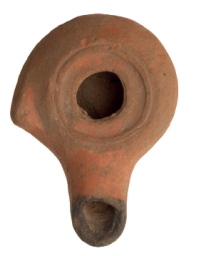
This style of lamp is the first lamps that were molded inside Egypt. Młynarczyk says that these lamps may have been inspired by other typologies, but ultimately provide a good starting point when looking at Greco-Roman era lamps. What is important in this lamp is it’s rather simplistic style. Without ornate details, it is a straight-forward lamp inspired by production models coming from the Greek world, Cyprus, and Delta islands (Chrzanovski, 2019). Important for this lamp is to understand the influence of design philosophy that was entering into and being replicated within Egypt.
Sanctuary Lamps:
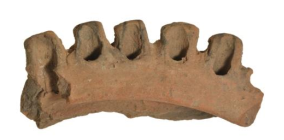
The so called “sanctuary lamps” are only named so because of the context they are predominantly found in. The findings in sanctuaries perhaps give evidence to their use as something specific in relation to cult function. For example, the lamp presented in Figure 2 comes from Naukrautis from a sanctuary of Aphrodite. They are typically made on a wheel with multiple nozzles and form a ring shape. This is markedly different style than the Młynarczyk A lamp presented prior, and it underlines the multi-functional role that lamps and lighting played in the ancient world. Fundamentally speaking, the spiritual contexts of these lamps would have been of great importance to both Greek and Egyptian patrons.
Frog-Lamps:
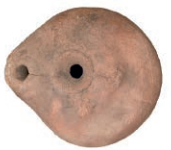
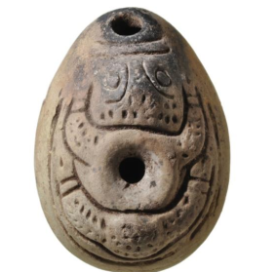
The frog lamps appear later in the Roman period and Early Byzantine Period (~1st-3rd centuries AD). These lamps are named because of the iconography of a frog that may appear on the body of the lamp. However, some of the earlier lamps known as “potato lamps” held a similar shape and were very plain in style (Fig. 3). The frog type is actually a wide array of various typologies and sub-types (Fig. 4), and therefore raises discussion. Knowles presented that this style of lamp was an indigenous style that was produced in Upper Egypt, however findings in Lower Egypt (at Naukrautis) have disproved this claim (Thomas). Mostly their shape is rounded and almost bulbous, however the amount of sub-types available make this particular style a larger topic. In any case the design is unique and certainly shows an Egyptian thematic influence on these lamps.
Lamps of the Gods
One of the more interesting topics when studying the Greco-Roman period in Egypt is the use of religious syncretism to harmonize the various cultures and faiths that lived within the realm. These lamps are an extension of that theme, made apparent in the material culture. Lamps appearing across the Greco-Roman world, from Alexandria to Rome, give us a good account of the variations in the presentations of deities that were apart of this religious syncretism of the time. These lamps appear in several different formats, sometimes containing a singular image of a deity while at other times combining two or even three deities at once.
Sarapis
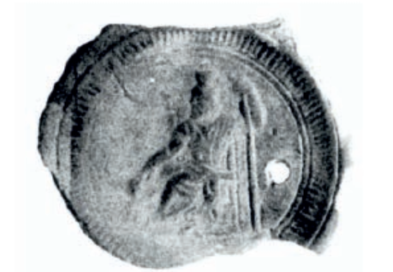
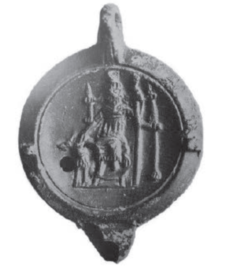
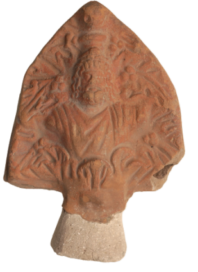
Foremost among the presented lamps are the ones containing the image of Sarapis (Fig. 5). It only underlines the importance of the status of Sarapis when the overwhelming amount of lamps featuring a single deity contain his portrait (Podvin, 2019). While the god has a complex history, he was celebrated inside and outside of Egypt by a broad populace (Hölbl, 2001). Variations of his image exist, from radiated to standing atop a globe, the manifestations he took on in terms of his image on lamps are, according to Podvin’s research, dynamic according to the region the lamps are present in. In other cases, some constants prevailed such as the image of Sarapis sitting enthroned (Fig. 6). At other times, Sarapis could appear on an attached handle (Fig. 7).
Isis
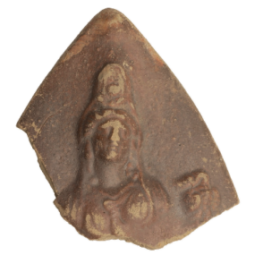
Considering Sarapis was the god of the king and Isis that of the queen (Hölbl, 2001), it is no surprise that she also played a prominent role on lamps featuring deities. Podvin notes that her appearance is typically that of a frontal facing bust. She appears most frequently on ornamented handles (Fig. 8) similar to the above mentioned handle depicting Sarapis.
Anubis
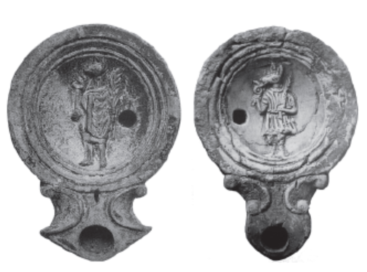
Interestingly, the motif of Anubis appearing alone on lamps was born outside of Egypt (Podvin, 2019). Remarkably, this theme became so popular on the Italian mainland that it even spread into parts of Gaul. In tune with Anubis’ relations as a god of the underworld, many of the lamps featuring his portrait were found in funerary contexts (Podvin, 2017). While the head of Anubis remained an animal, his attire was thoroughly Greco-Roman (Fig. 9). Curiously, lamps featuring Anubis do not exist within Alexandria at all.
Harpokrates
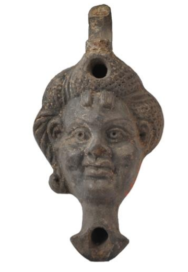
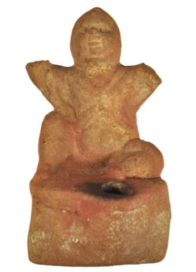
Harpokrates’ lamps are similar in their popularity compared to those of the Isis portrait lamps, and they often appear together in iconography (Podvin, 2019). Often depicted nude with varying attributes, Harpokrates has some rather curious designs. To demonstrate the richness of Egyptian variety, two lamps of Harpokrates (Fig’s 10, 11) are presented showing that the design philosophy behind the lamps themselves was not constant with the archetypes that were laid out by Młynarczyk. These lamps presented in particular share a common production source of Naukratis in Egypt. They were made from local materials and reflected the intricate work that was being put out by “local” craftsmen.
What do these lamps show us?
The most important thing to take from these presented lamps is that this is yet another facet of life within the Greco-Roman Egyptian world where the concept of syncretism was presented through the iconography. Artists did not shy away from creating syncretic interpretations of the deities, even ones like Anubis that were not so popular outside of Egypt proper. The diffusion of cultural and technology elements manifests itself most visibly in these lamps. It’s important to recall that lamps are a fundamental component of day-to-day life in antiquity. Their functions could range from the practical lighting of space to the spiritual and ritualistic function of prayer and meditation. That these concepts of syncretism reached even to items like lamps is perhaps an indication as to just how far reaching this idea was. It provides us with a rich contact point of study, for we see not only replicated typologies but also the presentation of the gods themselves. All of this gives a good account for the rich and special variety that existed in the material culture of the Greco-Roman Egyptian world.
Bibliography
Chrzanovski, Laurent. The Fortcart collection of lamps from Fayum. Polish Archaeology in the Mediterranean, vol. 28/1: Special Studies Ancient lamps from Spain to India. Trade, influences, local traditions. 2019.
Pawlikowska-Gwiadza, Aleksandra. Terracotta oil-lamps from Egypt’s Theban region in the collection of the Metropolitan Museum of Arts, New York. Polish Archaeology in the Mediterranean, vol. 28/1: Special Studies Ancient lamps from Spain to India. Trade, influences, local traditions. 2019.
Hölbl, Gunther. A History of the Ptolemaic Empire. Routledge, 2001.
Podvin, Jean-Louis. Isiac lamps from Alexandria and other provinces: some comparisons. Polish Archaeology in the Mediterranean, vol. 28/1: Special Studies Ancient lamps from Spain to India. Trade, influences, local traditions. 2019.
Thomas, Ross. Lamps in terracotta and bronze. Naukratis: Greeks in Egypt. British Museum.